Saturday, May 25, 2013

Even in Paradise, Birds vary in sizes & colors

No, this is not an post about birds, but about birds of paradise.

When you say Birds of Paradise, most see the Strelitzia Reginæ in their minds, a beautiful bright orange tropical flower, with a bright blue stamen, reminiscent of a bird taking flight.


Strelitzia Reginæ … Bird of Paradise

But few are those who imagine the very similar, but much bigger and less colorful version.  Nearly black and white, it is the bloom of the Strelitzia Nicolai, a much larger plant with leaves 5 to 10' long and that can develop a trunk and reach a height of 30' !!
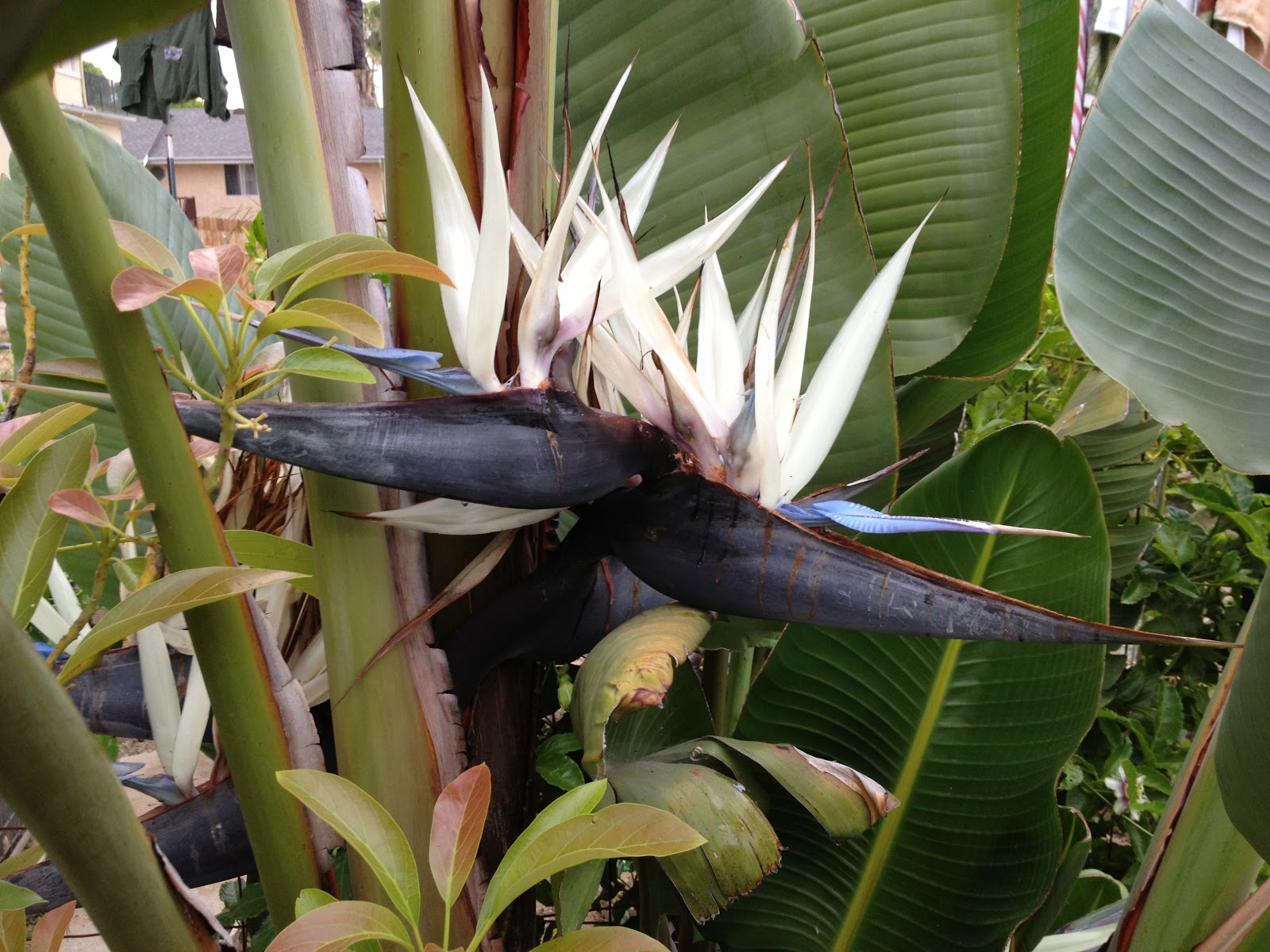
Strelitzia Nicolai … Giant Bird of Paradise
This bloom is about 5' from the ground and
its two flowers are about 12-18" each!
The regular Bird of Paradise (Stretlitzia Reginæ) can reach 4 - 6' in height with flowers up to 9" long and never develops a trunk.  So what the Stretlitzia Nicolai does not have in terms of flower magnificence, it makes up for it with huge, lush and beautiful tropical foliage.

Those are the two most common types of Birds of Paradise you will find in California.  But there are at least 4 other varieties.

Wednesday, May 22, 2013

Fava Beans, Crop that keep on giving


Over the Winter, I discovered fava beans.  It was purely accidental, from a bin at the supermarket.  They are xxl bean pods, about the size of a felt marker and I thought "I wonder if I could grow these?" So I bought a few and planted them.  Then, as is often the case (ie after the fact) I read up on them and discovered that they are a Winter crop here....  YEAHHHHH!!!  I was lucky with the timing.

They grew well in pots for a while, then I transplanted them to a very small area (about 2 sq ft) of the courtyard garden.  They continued to grow well and as we headed toward Spring, got taller and taller, until they reached about 2 1/2 feet and had to be staked (with bamboo skewers, so no biggie).

They bloomed and bloomed but no beans appeared, until about Spring.  Then, a decent number of beans started appearing on each plant and growing.

I started picking them as I walked by, eating them raw and sharing them with the dogs.  Then I had no time to look after them and they got very large, and they started being a little too fiber-rich to eat raw; even the dogs did not like them anymore.

So last Sunday, I harvested them and shelled them.  I also discovered that they have to be blanched for about 1 minute in order to be able to strip the harder outer layer of the bean.  So I did.  And inside each bean, was another softer, greener been that was rich and delicious, which we ate as part of a vegetable medley: home-grown carrots & fava beans with romano beans (also delicious though store bought).

But the amazing, almost magical, thing about fava beans is that they are a nitrogen-fixing winter cover crop.  The plant absorbs nitrogen directly from the air and grows well during the Winter when we get more rain and the weather is cooler.  Because they are nitrogen-rich, you can just work them into the soil after harvesting the last beans, where they can release their nitrogen, decomposing themselves and also fertilizing the soil.  How cool!!

So next Winter, expect to see more about fava beans.  And I won't be growing only a 2 square foot patch! Oh no!

I will also grow them twice: first in late Summer, early Fall, to harvest as a late Fall/early Winter crop, and second in the later Fall, to be harvested as a Spring/early Summer crop.  More on this in September!

Wednesday, March 6, 2013

Is My Weeding A Micro-Contribution to Global Desertification

TED Talks are fascinating, and this is no exception. But as I watched this one, I could not help but wonder how my gardening work fits in.

The talk is not about urban microfarms, but - in an itsy-bitsy, teeny weeny way - am I playing a role in greening or desertification...? Or am irrelevant?

I live in a city; cities are artificial deserts. But L.A.'s coastal valleys are natural ones too. Getting dryer? Probably, if not for the massive quantity of pipeline-imported water we flood our gardens with.

As I listened to Allan Savory, I think of my work.  My March garden is naturally green and lush with wild grasses and plants. So what do I do? I pull out the weeds out and expose the bare soil...

Weeding? - My Micro-Contribution to Desertification ?
I compost it all though, so nutrients are not shipped away in my yard waste bin. And I make mulch with the coast oak leaves and use it to cover the soil. I am also carving depressions with overflows, so that the fresh water from our big Winter storms does not make its way to the street, and down the storm drain to the Pacific Ocean.

But could I do more, something different, to help this tiny land we own thrive with life, naturally.  Was it not thriving with life when we bought it, after being neglected for decades?  Am I killing it, even with my organic methods? Can I do anything? A giant herd is out of the question... But with 10 chickens, could I mimic the grazing herds mimicking nature? In a very small way? Or is that ideal laughable?

If you are like me, this talk will throw you for a loop. But regardless of your background, Allan Savory's talk is fascinating and stimulating, like all TED Talks. It will challenge ideas you may have about climate change and cattle farming. Enjoy!