Tuesday, August 16, 2016

Euphorbia bicompacta


aka African Milk Bush

A great drought tolerant plant known by many names and introduced to me as an African Poinsettia.

I initially did not have a lot of success with this plant, but since planting it under a live oak, where it gets Summer shade and Winter sun, it's been thriving so long as I water it regularly.

Its leaves look soft but are oddly rubbery to the touch. It can be grown into a small bush or is suitable for container planting. It's also easy to propagate by rooting cuttings taken in Spring or Summer.

This plant has many common names. What do you call it?


Thursday, July 23, 2015

New Lawn in July?!! In SoCal?!!

Can you say "out of touch"?

New sod being put in a Northwest Pasadena residence being reno'd-to-flip
My jaw literally dropped this morning when I saw pallets after pallets of sod being delivered to a neighboring house currently being reno'd-to-flip.

It's not that I'm anti-lawn, but lawns are pretty big water wasters, not to mention the toxic-cocktail-upkeep they require to look nice. But this is Southern California in the middle of its worst drought in history?!! Give me a break!

Putting in a brand new lawn is hard enough to justify in this area, but putting one in on July 23?!! It's not only carelessness, it's borderline insanity. This is the time of year where the sun is at its hottest and where our average temperatures are at some of their highest (around 90ºF/32ºc). And they will continue to climb all the way through the end of August (to almost 92ºF/33ºc) and stay very high well into September. That's VERY HOT weather to be putting in new sod...

How they will be able to water it without breaking the city's ordinance will be interesting to see because the house is not occupied and the only permissible form of watering is by hand... Sprinklers can only be used twice a week and only either on Tuesday or Saturday... with no runoff...


Friday, June 26, 2015

At first birds ate all my fruit, then stopped...

About six Brown Turkey figs in the past few days.  Hooray, the birds are finally allowing me to eat some of my own fruit. Thank you Birds!

In all fairness, I think that in this part of SoCal, there was a shortage of food (in nature) this Spring especially to feed the little ones. My fruit production is several weeks late this year, across the board. I think this may be a phenomenon caused by our very warm winters these past couple years, but especially this year, as well as the drought. If everything is late, there could have been less foods than usual when the eggs hatched and the little ones needed to be fed. 

The problem went away by itself in the past week or 10 days. No netting or other anti-bird measures required. 

I do strongly believe that gardening is a partnership. We do not do all the work so we should not reap all the rewards. I love birds and they take care of a lot of pests. 

Better pay the birds in kinds than giving our hard-earned cash to Monsanto, Bayer, Dow Chemical and the likes. 

Maybe I romanticize the whole thing a bit, but at the same time, I really want to give my new ecocentric method a good try. And so far, so good. Even though the year had not started too well, I think we may be back on track. 

Sunday, April 5, 2015

Misunderstood Insects FAQs - CRANE FLY

  • look like mosquitoes, but are actually a fly
  • spend their very short lives (a few days) attempting mate and lay eggs
  • do not bite/sting (nor eat as adults)
  • do not carry diseases
  • prefer moist areas but are attracted to light at night, which is why they enter our homes
  • are eaten by birds, fish, small mammals
  • start out as larvae & pupae that feed on decomposing material and are eaten by animals and birds
  • are considered mostly beneficial, but in the absence of predators a very high number of larvae can cause damage to turf grass
  • are present everywhere in the world, though many local and regional species exist and the ones you see can be native or non-native

As annoying as they can be in our homes, they do absolutely no harm.
More information: http://goo.gl/3OjLF8

Photo credits: napamosquito.org

Tuesday, February 3, 2015

Finally, common sense to stop massive food waste!

Since May, Belgian supermarkets must donate unsold food still fit for consumption to charity.

“The move followed proposals by the European Union to scrap compulsory “best before” labels on coffee, rice, dry pasta, hard cheeses, jams and pickles to help reduce the estimated 100 million tons of food wasted across Europe each year.”

It's about time someone take concrete action to address food waste while so many folks are starving in the world's richest and poorest countries alike.

Check out this article:


Thursday, March 6, 2014

CANNING ORANGES (2 useful videos)

Disclaimer: Before attempting to can foods, you should already have a good understanding of canning  and have the required equipment. Dangerous bacteria can develop in incorrectly processed canned foods. You should have sufficient knowledge to judge for yourself whether this information is reliable. Read full disclaimer below.
We live in Orange Country. Like many homes in Southern California, ours was built in an orange grove.

Not only is our climate and soil perfect to grow many types of citrus, but our property has old (almost historic) and mature orange trees left over from the old days when this was prime orange growing land.

Most varieties of orange trees (and citrus) in our area give a winter harvest, somewhere between December and April. We harvest the fruit gradually, because we only pick the fruit when it's fully ripe, still on the tree, but when it comes off by just lifting it slightly.

But if you have orange trees, you know that picking only ripe fruit does not mean that you will have only a few oranges at a time. A few oranges for me is anywhere from 20 to 80 lbs (at a time), depending on how often I check the tree! And that's way more than we could possibly manage to eat.

We give oranges to neighbors, friends, family, delivery people, etc., but we still end up with more than we could possibly eat fresh. There is no way I will let hundreds of pounds of delicious oranges go to waste, even though we do not really waste anything: what grows here stays here, even if it's to become compost. But rather than using the oranges for compost, canning or freezing can go a long way in ensuring that you have fruit from the garden year-round.

Our house came with an old ACME juicerator, so it's easy for me to make lots of orange juice, and freeze it, but with the amount we need to preserve, canning is more economical because you use energy to can the fruit, not to store it. Not to mention the fact that with so much to freeze, one huge freezer would not be enough. I hate to think what my electric bill would look like if I had multiple freezers...

Canned oranges it is, then!

I find it hard to find good, reliable canning information. Proven techniques to can various types of food, like Grand'Ma used to make. But while searching, I came across a couple videos and people who seem to know what they are talking about and share their experience on video to help others.

Check the videos below disclaimer.
Disclaimer: I cannot guarantee that the methods demonstrated in the videos are correct of safe. It is imperative that you educate yourself about canning techniques before attempting to can foods, so you can do it as safely as possible AND so the food you preserve is safe to eat and will not make you ill (eating improperly canned foods can lead to botulism, which can be fatal.)
The canning process also involves the use of very hot liquids as well as, in some instances, the use of a pressure canner. Pressure canners allow the jars to be processed at extremely high temperatures (much HOTTER than boiling water.) AND as they are removed from the canner, the canned food jars are not only SUPER HOT, but also under high pressure as long as they remain hot. 
Before attempting to can foods, you should already have a good understanding of canning  and have all of the required equipment. Dangerous bacteria can develop in incorrectly processed canned foods. You should have sufficient knowledge to judge for yourself whether this information is reliable.


I find the above video more useful overall, because it covers the actual canning of the fruit, but the following one is from Granny Miller, whose videos contain a wealth of hard-to-find details for the novice canning enthusiast. Be sure to check her other videos. I find them both useful and inspiring.


Happy Canning!!

Friday, February 14, 2014

Sweet & YUMMY !!!

 From Homegrown Sugarcane 
 to make Homemade Syrup 

It worked…!  Wow…! 

Did it! Used homegrown sugarcane to make something useful. 
And it was easy as 1 - 2 - 3.

Taste is quite similar to molasses, but sweeter, clear, and with a deep orangeish-red color. I LOVE molasses, so I'm happy with this new truly natural, organic and vegan syrup.

The only drawback is the amount you get after boiling it down. Similar to when boiling down maple syrup, but you get a bit more, perhaps. I started with about 3-4 cups of juice after pressure-cooking. I finished with about ¼ cup of syrup.

ALWAYS USE UTMOST CARE: Hot sugar liquids are very dangerous and should never be handled except by responsible adults fully capable of performing such task safely at all times. See "CAUTION" below.


What I did:

Placed washed, peeled and split cane pieces, covered with filtered water, in a pressure cooker pot.

Cooked in an electric pressure cooker, for speed and simplicity. I cooked on the steam program for about 1hr.

Transferred the juice to a pot and boiled it down on the stove. In hindsight the pressure cooker's "sauté" program might have simplified the task a bit.

Removed from the heat at the thread stage (candy cooking temperature). Next time I'll stop a bit earlier so it's not quite as thick once refrigerated.

CAUTION (MUST READ): Before you decide to do this, make absolutely certain that this is a task you are able to handle safely. Ensure children and pets are not nearby, unsupervised or in your way, and that you are always able to and paying full and continuous attention to the work at hand. Your work area should be clean and free of obstructions. Do not leave this process unattended. Boiling sugars are EXTREMELY HOT and VISCOUS. They can cause SEVERE BURNS and the liquid's viscosity may worsen injuries. UTMOST CAUTION should be exercised when handling this substance in order to prevent injuries to yourself, others or pets. 

Note: On the photo, the cane segments are whole, but I later decided to split each segment in ½, then each split segment into 3 or 4 wedges.

Acknowledgement: Thank you to David, blog author of Florida Survival Gardening for the great idea. I modified the process slightly, peeling the cane and using a pressure cooker, but I otherwise followed his instructions.

Thursday, February 13, 2014

Making sugarcane syrup without a press

David, author of Florida Survival Gardening blog explains how to make Sugarcane syrup at home, without a press.

I've been growing sugarcane for a couple years now. It grows fast, is quite prolific and does not need as much water as I had thought. I've been looking for a way to extract the juice, but the cane juice extractors are so expensive and I have no idea if they are any good, where to get them serviced if they break, etc.

And how can I ever recoup the cost of such a purchase, unless it lasts literally forever…

I found one local reseller of extractors, and several distributors across the Pacific. Not a simple purchase and a lot of the cost is shipping (actually higher than the actual extractor in many cases.)

I may give David's method a try, and I will also see if a pressure cooker might be helpful in reducing the extraction time, as opposed to just boiling the cane in water.

Straining Air for Water...

Or, in other words, harvesting the humidity in the air.

With well-below-normal precipitations now 3 years in a row, this may be worth trying if you live in California. The ground is very dry and significantly deeply.

goo.gl/pPeZyJ

FAI's "Natural" Effect

100% Natural Foods!!!
Brought to you by FAI*

I found this gem while looking for a way to make sugarcane juice/syrup without a sugarcane press (because they are SO expensive and I cannot find a decent one stocked in the U.S., let alone made here…  More on that in another post.)

A little big long, but gets interesting around 0:02:21


*False Advertising Industry

Tuesday, January 14, 2014

Life Cycle of a Tomato Hornworm

This is so interesting… Yellow jackets are a predator for tomato worms. Something to remember next time I get annoyed at yellow jackets when I'm trying to barbecue something…

A little long, but worth watching.

Sunday, September 8, 2013

Peanuts

Such an American staple, yet peanuts originated in South America. I was fortunate to obtain peanuts seeds from the USDA for testing. Initially I wasn't sure it would be a good crop to grow in Southern California. Even though my experiment is not over or conclusive, I get the feeling that with a bit more TLC, peanuts can thrive during our long and hot Summers.

If this is something you would like to try keep in mind that peanuts require about 4 months of heat, which will make it a very difficult plant to grow in many areas.

TLC-wise, I probably just have to make sure to provide more regular waterings than I did this time. And I should probably apply some natural fertilizers as the plants grow and bloom, as well as gypsum at bloom time as recommended by the Western Garden book of edibles (even though in this case blossoms were a few at a time but nearly continuous). This time I only fertilized when I sowed the seeds. 

I have to say that the plants did and continue to do very well. I had absolutely no pest or disease issues whatsoever. However a tomato plant in a higher bed, behind the peanut test area, grew invasively and at one point nearly covered the peanut bed. And because I took too long to clear its invasive limbs , I think the peanut plants were set back several weeks, even though they did not yellow or seem to have otherwise suffered from lack of light like many other types of plants would have. 

The plants are supposed to eventually die back and even though harvest should technically be after 120 days (very soon since I started in May), the plants are still green, thriving and blooming.

Out of curiosity I dug and searched for a sample peanut pod near one of the plants with a flower that appeared to have sent a shoot in the ground (that's where the peanuts appear). And I did find a pod. It's not yet harvest time so I only took out the one.

The pod is not shaped like I expected and I'm not sure if the ground was maybe too hard or if the shape has to do with this variety of peanuts which came from Ecuador. I'll probably know for sure at harvest time. 

Also, I'm not sure if this is typical but only about 8 seeds out of 25 germinated, which seems like a very low rate of germination. It could be because of my less than regular waterings though. I'll have to correct the problems in my next attempt, and see if the germination rate improves. 

Very likely I will only harvest enough peanuts to provide me with seeds for 2015. So I'm not sure how many I will be able to sample, for taste. But it is a fun experiment nonetheless. 

I will write more about the actual result at harvest time. 


Monday, August 12, 2013

Composting Faster

Please take a moment to rate this by clicking one of the boxes at the end.
Composting is fairly easy if you know the basics: Add a layer kitchen scraps; Add a layer of dead leaves; Start over... With time, the bottom layers transform themselves into "black gold," this amazing living matter full of nutrients, beneficial insects and microorganisms which will make your plants thrive!

But you need time AND patience, like saving with a piggy bank. Time passes and little by little the layers accumulate and one day: surprise! rich compost! 

But if you need your compost faster than you are able to produce it, you end up having to buy expensive organic soil amendments and fertilizers to supplement your needs instead of being able to use only your own high-quality home-produced compost.

Here are a couple tools, tips and tricks that should help you get the job done faster AND better. Better, because if you are composting weeds with their seeds, you want to make sure weed matter is destroyed, so your compost isn't going to help propagate weeds all over your garden..!

Compost Thermometer - Don't stop reading here! Using a compost thermometer is not as crazy as it might sound. 


Reotemp 20" compost thermometer. Excellent reviews
and as little as $25 on Amazon.
How hot your compost pile is has to do with the level of micro-organic activity in it. Hotter = working faster! High temperature also helps destroy weeds and their seeds as well as some pests, so it does not only speed things up, but does a more thorough composting job. 

A cool pile can easily take a few months to turn into compost, while a hot pile can become compost in weeks! Yes! Weeks!

Plus, during the Fall or Winter months (depending on your location), watching the temperature may prevent your pile from going completely dormant because it gets too cold and even starts to freeze. Though it may be hard to prevent if you live in a very cold winter area.

The thermometer allows you to gauge two important things: 1) aeration and 2) moisture. This in turn saves you work because it tells you when you can sit back and dream about the black gold that is being made, or when you need to do a little bit of extra work to make sure the process doesn't slow down or stop.

Here is what to watch for:

Compost is hot (100ºF +) - micro-organisms are chugging away. So most likely you don't have to do too much. No need to aerate or turn the pile yet. Just make sure that you add some water if the pile is not moist enough (especially if it's very hot outside, and/or your pile is very hot). Be careful not to add water that is ice cold, or this could send your pile temperature into a downward spiral.

Temperature dropping - things are slowing down. Find time to aerate the pile by turning it over and mixing it a bit. Also ensure it is sufficiently moist by adding water if necessary.

Compost is extremely hot (130ºF +) - this should not happen unless your pile is very large, but DO NOT LET YOUR PILE get above 130ºF. It is a FIRE HAZARD! Water your compost with cold water. Remove material from the pile and form smaller piles elsewhere to slow things down and make the pile cooler.


That brings me to my Tip & Trick #2

Aeration tool

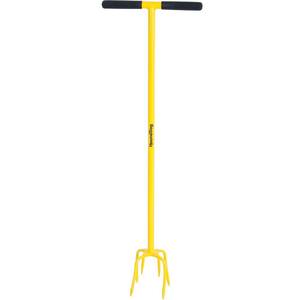
You may already own a compost aerator, or maybe you use another tool already, like a hoe. But if you don't have anything or aren't satisfied with what you use, you may want to give the Hounddog Stand-up Cultivator a try. Turning your compost pile can be a back-breaking exercise, but it does not need to be if you use the right tool. The stand up cultivators allow you to use your arms, not your back!


Hounddog Stand-up cultivator. Strong, sturdy, versatile.
In the U.S., you should be able to get one for under $25 from Home Depot or Amazon


Made of robust metal, I find that this tool works great to aerate compost. But more importantly, it works well to cultivate the soil all over the garden too. It's definitely not a 1-trick pony. 

Also, it's very reasonably priced and you can find it at both the Home Depot and Amazon for under $25 in the US. Lowes has another version of the same tool, for around the same price or a little bit higher, but still reasonable.

I use this tool to rotate the content of the compost. 

Turning it pointing straight down - rotates the decomposing materials horizontally from the corners or the edges to the center of the pile, where it can get hotter.

Turning it while holding the tool slightly tilted - rotates the decomposing material vertically, bringing lower layers closer to the top, and moving top layers further down. Note that if the lower layers have already turned into compost and you plan on removing compost from under the pile through the bin's bottom doors (if you have that type of bin), you may want to hold off on this step to avoid mixing the compost that is ready with the materials that have not yet decomposed.

The temperature of your compost will vary depending on weather, but here in Southern California, I can usually maintain it between 90ºF and 115ºF year-round, even during the colder winter months when our nights are long and cold (low 40's to mid 30s) and our days short and cool (mid 50's to low 70's). Do keep in mind if you are doing cold-weather composting and must add water to the pile that adding cold water from the hose will cause a sudden drop in compost temperature, therefore slowing down the process!

I hope this article was useful for you. Do let me know if this helps you with your composting. Do not hesitate to post any questions or suggest other composting topics which would be of use to you.

More on composting in future articles.

Please take a moment to rate this by clicking a box below

Saturday, August 10, 2013

Basil going to seed?

My basil does well for months and months so long as I do 4 simple things:
  1. Do not let it dry too much between waterings.
  2. Give it nitrogen-rich food (I use steer manure or blood meal) when it starts wanting to go to seed too aggressively. 
  3. Prune it back to a few new small fresh shoots to allow it to grow back. 
  4. Pinch the flowers off to stop it from going to seed
The plants wanting to go to seed is my biggest problem. If I have to pinch back buds more than once a week, then it's time for manure or blood meal. I find that method works well for me. 


Tuesday, June 25, 2013

Use China Marker
Food is costly! Don't waste it.
Using a China Markers, write on containers
when food was made, or package opened!
Hot soapy water removes writing in a jiffy!

Saturday, May 25, 2013

Even in Paradise, Birds vary in sizes & colors

No, this is not an post about birds, but about birds of paradise.

When you say Birds of Paradise, most see the Strelitzia Reginæ in their minds, a beautiful bright orange tropical flower, with a bright blue stamen, reminiscent of a bird taking flight.


Strelitzia Reginæ … Bird of Paradise

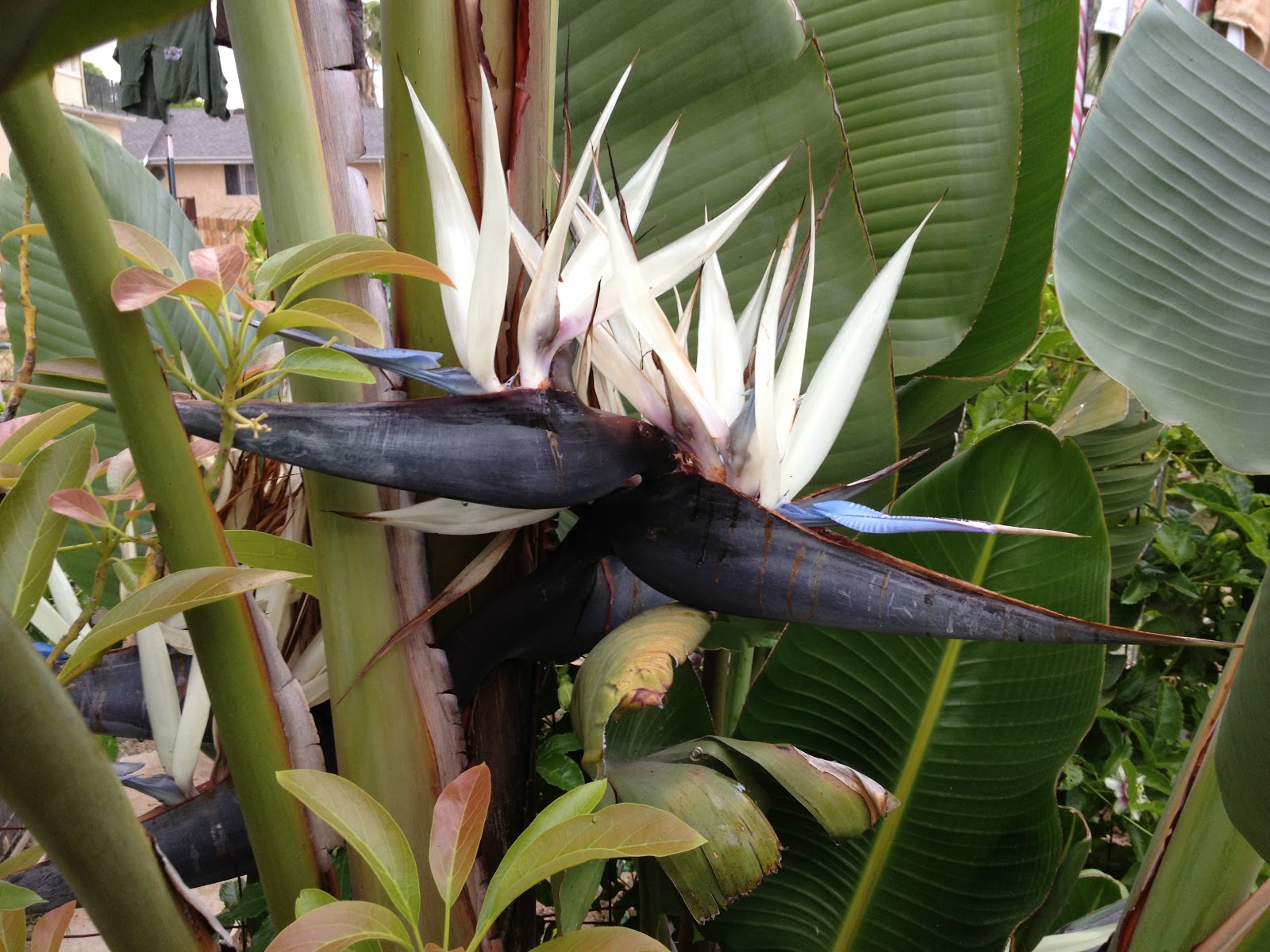
But few are those who imagine the very similar, but much bigger and less colorful version.  Nearly black and white, it is the bloom of the Strelitzia Nicolai, a much larger plant with leaves 5 to 10' long and that can develop a trunk and reach a height of 30' !!

Strelitzia Nicolai … Giant Bird of Paradise
This bloom is about 5' from the ground and
its two flowers are about 12-18" each!
The regular Bird of Paradise (Stretlitzia Reginæ) can reach 4 - 6' in height with flowers up to 9" long and never develops a trunk.  So what the Stretlitzia Nicolai does not have in terms of flower magnificence, it makes up for it with huge, lush and beautiful tropical foliage.

Those are the two most common types of Birds of Paradise you will find in California.  But there are at least 4 other varieties.

Wednesday, May 22, 2013

Fava Beans, Crop that keep on giving


Over the Winter, I discovered fava beans.  It was purely accidental, from a bin at the supermarket.  They are xxl bean pods, about the size of a felt marker and I thought "I wonder if I could grow these?" So I bought a few and planted them.  Then, as is often the case (ie after the fact) I read up on them and discovered that they are a Winter crop here....  YEAHHHHH!!!  I was lucky with the timing.

They grew well in pots for a while, then I transplanted them to a very small area (about 2 sq ft) of the courtyard garden.  They continued to grow well and as we headed toward Spring, got taller and taller, until they reached about 2 1/2 feet and had to be staked (with bamboo skewers, so no biggie).

They bloomed and bloomed but no beans appeared, until about Spring.  Then, a decent number of beans started appearing on each plant and growing.

I started picking them as I walked by, eating them raw and sharing them with the dogs.  Then I had no time to look after them and they got very large, and they started being a little too fiber-rich to eat raw; even the dogs did not like them anymore.

So last Sunday, I harvested them and shelled them.  I also discovered that they have to be blanched for about 1 minute in order to be able to strip the harder outer layer of the bean.  So I did.  And inside each bean, was another softer, greener been that was rich and delicious, which we ate as part of a vegetable medley: home-grown carrots & fava beans with romano beans (also delicious though store bought).

But the amazing, almost magical, thing about fava beans is that they are a nitrogen-fixing winter cover crop.  The plant absorbs nitrogen directly from the air and grows well during the Winter when we get more rain and the weather is cooler.  Because they are nitrogen-rich, you can just work them into the soil after harvesting the last beans, where they can release their nitrogen, decomposing themselves and also fertilizing the soil.  How cool!!

So next Winter, expect to see more about fava beans.  And I won't be growing only a 2 square foot patch! Oh no!

I will also grow them twice: first in late Summer, early Fall, to harvest as a late Fall/early Winter crop, and second in the later Fall, to be harvested as a Spring/early Summer crop.  More on this in September!

Wednesday, March 6, 2013

Is My Weeding A Micro-Contribution to Global Desertification

TED Talks are fascinating, and this is no exception. But as I watched this one, I could not help but wonder how my gardening work fits in.

The talk is not about urban microfarms, but - in an itsy-bitsy, teeny weeny way - am I playing a role in greening or desertification...? Or am irrelevant?

I live in a city; cities are artificial deserts. But L.A.'s coastal valleys are natural ones too. Getting dryer? Probably, if not for the massive quantity of pipeline-imported water we flood our gardens with.

As I listened to Allan Savory, I think of my work.  My March garden is naturally green and lush with wild grasses and plants. So what do I do? I pull out the weeds out and expose the bare soil...

Weeding? - My Micro-Contribution to Desertification ?
I compost it all though, so nutrients are not shipped away in my yard waste bin. And I make mulch with the coast oak leaves and use it to cover the soil. I am also carving depressions with overflows, so that the fresh water from our big Winter storms does not make its way to the street, and down the storm drain to the Pacific Ocean.

But could I do more, something different, to help this tiny land we own thrive with life, naturally.  Was it not thriving with life when we bought it, after being neglected for decades?  Am I killing it, even with my organic methods? Can I do anything? A giant herd is out of the question... But with 10 chickens, could I mimic the grazing herds mimicking nature? In a very small way? Or is that ideal laughable?

If you are like me, this talk will throw you for a loop. But regardless of your background, Allan Savory's talk is fascinating and stimulating, like all TED Talks. It will challenge ideas you may have about climate change and cattle farming. Enjoy!

Saturday, February 9, 2013

The Vanishing of Bees

I'm only half way through this but already felt it's worth sharing, because it gives an insight into agribusiness from a new angle: the pollination of crops.

Some of the reviews I read on Netflix are critical of it for being overly religious.  The jury is still out on this as far as I'm concerned but that may be because I'm only 1/2 way through.

God is mentioned in the film, and a lot more than once. And the most prominent people in the movie are very religious.  But I'm not convinced that the the point of the movie is going to be the rapture. But those who made the critical reviews might have watched the whole movie while I haven't. Let me know your thoughts if you take a look at it.

This is both interesting and disturbing and yet another snapshot of agribusiness and how lack of finesse with Nature.  Agriculture is now an industry and it's eerily similar to other industries, whether they build cars, refine oil, or make steel. The agricultural industry produces plants to make food or feed

And when I look at agricultural workers, at all levels, I see people like us.  Some just do their jobs, some do it more reluctantly occasionally stopping to scratch their heads and themselves "what on earth are we doing here??!!"

See for yourself.  Hopefully this preview will make you curious enough about this documentary to watch it yourself.  It's available on Netflix for streaming.

Thursday, February 7, 2013

Botany of Desire & apple tree seedlings experiment

With *video previews!

* Please let me know if the video is not available where you are.  I know it is here in the United States, but I do not know whether this content is made available elsewhere in the world.

The Botany of Desire is a fascinating documentary about the world from the point of view of plants; how certain plants may be gratifying our desires for their own purposes.  


This film is about 4 plants that have travelled the road to success by satisfying human desires (1). 

I was fortunate to learn about this through the book on which this documentary is based, also called The Botany of Desire, which was graciously given to me as a present by our long-time friends, Juliet Huntly and Michael Cooke, during their March 2010 visit, when they asked me to come with them to tour the Huntington Botanical Garden, which I had been dying to see since moving to Southern California.
The tulip, by gratifying our own desire for beauty has gotten us to take it from its origin in central Asia, and disperse it around the world...  Marijuana, by gratifying our desire to change consciousness, has gotten people to risk their lives, their freedom in order to grow more of it, plant more of it. The potato, by gratifying our desire for control, a control over nature, so we can feed ourselves, has gotten itself out of South America, and expanded its range far beyond where it was 500 years ago. And the apple, by gratifying our desire for sweetness, begins in the forests of Kazakhstan, and is now the universal fruit! These are grate winner in the dance of domestication.   <...>  And this relationship with the plants learning how to gratify our desires and our working for them in exchange for this is what I call The Botany of Desire (1) 
When Juliet described the book to me as we visited the Huntington's gift shop, I was a bit puzzled because it did not seem like her to be talking about a book that really sounded  weird.  After they gave it to me, I distractedly skimmed over the first couple pages and it seemed to confirm my first thought.  But a while later, with more time on my hands, I started reading it and thought it to be the most fascinating idea.

Humans often see ourselves as the center of it all.  Even though we are continuously reminded by Mother Nature that we're not in control of it all, we pretend that we are.  So this was for me the beginning of an awakening, of looking at nature and the billions of life forms that surround us, just here on earth, as separate entities with their own needs and their own goals, so to speak.

All of us, earth's life forms, are interdependent but not independent or separate from one another.  We are a whole. It taught me a new respect for nature and is now helping me rethink my place, my role, as a a living thing, being given an opportunity to participate in this continuously evolving scheme that we are a part of but don't fully comprehend.  In other words, it made me a little more humble.


(1) quoted from the documentary The Botany of Desire, by Michael Pollan

More information in addition to this preview can be obtained on the PBS website at:
PBS - The Botany of Desire

Interested in my apple seedling experiments, then click here!